Showing posts with label 2010. Show all posts

Tuesday, February 8, 2011

The Sussurus of the Stream and a Royal Gift


Let us share our textile skills with others - 
give a beautiful life-time gift to a child! 

An onomatopoeic word from the Latin susurrus (“a humming, whispering”); ... silence so profound that I could hear the susurrus of the blindfold's soft ...
Whispering, murmuring, or rustling: "the susurrus of the stream" (Merriam-Webster - The Free Dictionary Latin, hum, whisper — more at swarm. First Known Use: 1826.)  

LISTEN: There is an orchestra of perfect silence to sooth our hectic and rushed thoughts and actions: Yarn - the "susurrus of the stream" - as it glides through your hands and imparts its desire to become a beautiful river of joy and delight. It hums and whispers as it releases itself from a skein or ball, glides through our hands and settles in interlocking loops. Knit me a River by Jane Thornley one of those fine examples where your fingers follows your mind or vice versa, providing you with the ensorcelling realization of being truly creative.

Working with one's hands has always had a calming effect on people. Watch a child being busy discovering the world around her or him - hands on. Let your child explore as many routes as you can safely tolerate. A great way of opening up an life-long path of joy is letting them work with a crochet hook or knitting needles, with a Lucet, a knitting bobbin with 4 or 5 pins, or any tool yarn-handling tool. Finger knitting is the most perfect way for getting those little fingers used to handle strands of yarn. Look at the relatively short time a child needs to get basic skills in yarn language - and in return has a skill lasting a lifetime.

When teaching children how to knit or crochet I always found it very helpful to use very large needle or crochet hook sizes and a bulky yarn to demonstrate the process and they could follow the path of the yarn much more easily and the tools would not slip and the stitches remained visible and on the needle!

Knitting and crochet - these skills equal a language without words. It is understood everywhere.
In Shanghai I sat on a bench at the Bund overlooking the Huangpu River towards Pudong, with my knitting - and pretty soon a lot of people gathered around me, mostly women, smiling, chatting, moving their hands, demonstrating that they, too, knew how to knit and how strangely I was moving my needles and how quickly the stitches flew on my right-hand needle and pretty soon these Chinese knitters took over, added their own way of purling and knitting and yarn over and row after row everybody had a go at it and the piece became a wonderful swatch demonstrating unified trans-global knitting skills!

Written languages hidden in textiles have been known for centuries. One of the most treasured, interesting and least known was Nu Shu (Woman's Writing in Chinese), a means of communication between women, hidden in embroidery or written in a secret alphabet. A report on Nu Shu is a worthwhile read, while for an entertaining story based on the skills of Nu Shu turn to author Lisa See's book  Snow Flower and the Secret Fan: A Novel.

Knitting and crochet - an incredible source of strength for coping with the vicissitudes of life.
Look at the amazing blog of Helen MyHeartExposed. Against all odds Helen is facing life head-on, struggling between long periods of pain and moments of joy with her favorite crafts. Her incredible skills are best viewed in this project for Jane Thornley's Autumn KAL.

Thursday, December 16, 2010

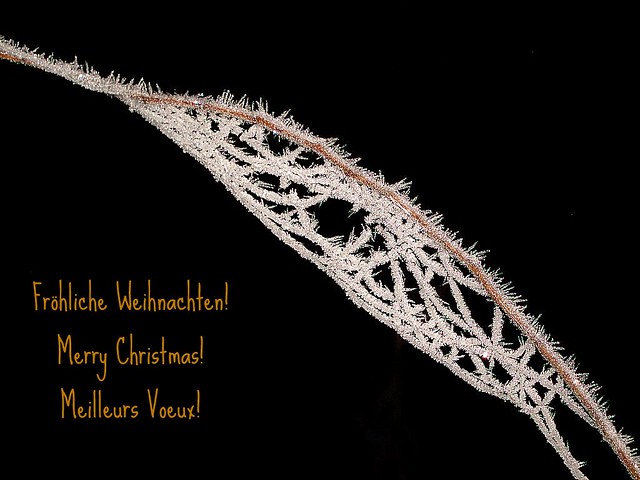
Merry Christmas and a Peaceful New Year !


Ich lebe mein Leben in wachsenden Ringen

Ich lebe mein Leben in wachsenden Ringen,
die sich über die Dinge ziehn.
Ich werde den letzten vielleicht nicht vollbringen,
aber versuchen will ich ihn.

Ich kreise um Gott, um den uralten Turm,
und ich kreise jahrtausendelang;
und ich weiß noch nicht: bin ich ein Falke, ein Sturm
oder ein großer Gesang.

I live my life in widening circles
that reach out across all things
I may not complete this last one
but I give myself to it.
I circle around God, around the primordial tower.
I've been circling for thousands of years
and I still don't know: am I a falcon,
a storm, or a great song?
~ Rainer Maria Rilke ~

20.9.1899, Berlin-Schmargendorf

Saturday, December 11, 2010

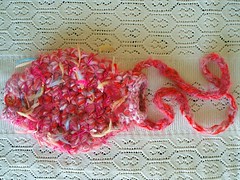
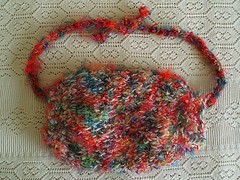
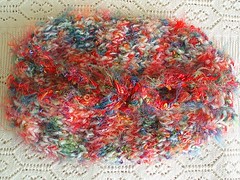
No Chill Three - A Muff Bag for the Little Baroness

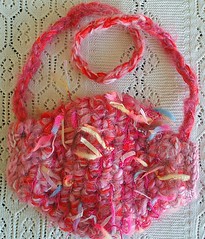
A double-purpose bag for The Little Baroness:
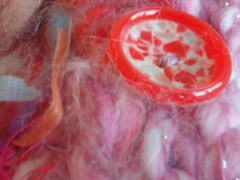
Closing one end with a doubled button and
inserting the Lucet-woven cord at the other
end into the gaps of the knitted fabric - a
perfect little bag for essentials (second picture)
Open the button and run the cord through gaps at
both ends - and you can hang the muff around
your neck, keeping your hands snug and warm
inside (first picture).
This is the third muff in the No Chill Series.


Friday, December 10, 2010

Monday, November 8, 2010

No Chill Two

Cold temperatures and whistling winds
call for warm accessories.
Muffs are my personal favorite! The word comes from muffula (fur mitten). This muff is made in brioche stitch with three different handspun yarns, knit in the round. I handstitched some tulle into the muff for an additional accent of fluffiness. The separate neckband cord is luceted, run through the muff as needed and tied behind the neck. I did not attach it so the muff can be used without it as well.
These little muffs are lovingly called "Staucherle" (meaning to push up without rolling in the material first, a wave-like effect) or Vorderärmel (front sleeves) in the German Swabian dialect. Pulswärmer (pulse warmer) was another word for a short wristlet. My great-grandmother also used to cut off the top part of worn-out woolen stockings (at the end of the 18th century), which usually was in much better condition as the rest of the handknit woolen stocking. She then crocheted or embroidered a nice edge around at both ends, completing the rounds with a yarn-over knit-together pattern and a kitchner-type bind-off, wove an
I-cord or even a ribbon through the holes and wore these instant Staucherle as elongated muffs or wrist-to-elbow warmers. They were worn either over the sleeves of a dress or under them, often also under a socalled "Kittelschürze", an apron-type cotton dress worn for work. Today's versions have almost always short sleeves or are sleeveless. In French, a muff is called un manchon.
No Chill Series:
One, Two, Three

Friday, October 29, 2010

Soul Warmer - Soft and Simple

A soft and bulky yarn, Lana Grossa Ragazza Lei,
was perfect for this small seamless shrug/bolero.

The pattern is Lynn's Shrug, from Trish Woodson.
It is a quick knit, but please note that the pattern is
not very precise.
If you want to have your shrug looks like in the
pictures, you will have to read the pattern very
carefully and reverse the positioning: CO the
side panels where the front panels are supposed
to be and vice versa.
An invisible three-needle bind-off makes it just
perfect - and the little soul warmer will hug you
nicely during all those wintery days ahead.

Sunday, October 17, 2010

Refound Love for Lucet

For some time now I've been admiring the airy Lucet necklaces made by Marie-Christine. A friend of hers custom-made this wonderful wooden Lucet for me and I took to the craft as if I had never been away - never in this case being exactly 65 years. The joy is still the same although the hands may perhaps be a bit slower. I had made a friend in New York through Ravelry and sent the necklace to her, a very talented freeformer - her Walk Through the Woods (A famous play with Sir Alec Guinness, on stage in London in the eighties) resulted in a lovely project on Ravelry called Path through the Forest. Here's my re-first Lucet necklace.

Thursday, September 9, 2010

Bonsai Tri Angle Bag

Mini-Triangle KAL, Jane Thornley: I started a modular Wrap in the most light-weight kid silk haze - and ran out of yarn. So until the rest of the yarn I ordered for my Tri Angle Wrap arrives, I started two mini-mini-Kals, one is completed: a tiny azuma bukuro bag, knitted instead of sewn. With my antique white and green silk embroidery floss from Schürer (J.S. 20) I knitted three "squares" in one piece in seed stitch, each with a diagonal yo k2tog
(see drawing) which makes the tiny picot edge at
the bottom and helps define the folding lines.
For finishing, it requires two seams, joining the diagonals in front and back.

In Japan, an azuma bukuro bag is made of fabric and knotted with the pointed ends. It is so practical, it folds flat, can serve as a protection against wind and rain, a small apron, and as far as volume is concerned you'd be amazed just how much goes into an azuma bukuro bag! It is also great to carry knitting stuff, including long needles! They are quick to make out of fabric and make nice gifts.

Japanese Packaging is an art in itself. Here are just a few methods. If you are interested, see this link and this one for reading Japanese Knitting patterns.

Sunday, September 5, 2010

Sunset in September 2010


A masterful painter used a delicate brush to give us this amazing view of an evening sky.


One should ask in this context whether these clouds belong to anyone, such as
apparently trees, plants, flowers, sand and rocks, water and rain, wild animals...
An interesting article on trees being a symbolic Commons, written by Prof. Rainer Rilling.
Also see this book: Privatising Nature

Sunday, July 4, 2010

A Kimono with No Stars but Stripes - and the French Connection

Almost a quarter of a century ago I knitted the first prototype of this Kimono Vest. It was knit in separate stripes with yarn and fabric strips (strippons), the individual stripes variably connected with buttons, ribbons or hooks. The very first Kimono Vest turned out nicely and I wore it to shreds!

Two, three models later I had the pattern perfected and my little interchangeable Kimono Vests were an indispensable item of my summer and winter outfits, also great for travel, covering bare shoulders, spiffing up tops and adding color, character and rendering that special eye-catcher look.

I would just pack a couple of stripes and assemble them as the mood would strike me, and the mathematicians can figure out just how many different models one can be made of 8 stripes of different color!

So here's a description of how you can make your own versatile
modular Kimono:

Structure: make at least four strips reaching from the bottom of the front to the bottom of the back, for a shorter bolero type Kimono this would be shorter than for a vest or cardigan length Kimono. Make one strip for the center back, reaching from the back of your neck to the bottom of the back. Of course you can do a narrow triangle as a center back piece as well.

You can CO the same number of stitches for for each strip if e-quality rules your house. Or you can make some strips wide and some strips narrower, main thing is that you can combine them to about the same full width (measured from the BO-end of one "sleeve" to the other. The strips can be knitted or crocheted with any pattern you like as long as it allows the strip to have a relatively straight edge to be tied to the next strip. They can even be different in length if you wish to have a Kimono with an uneven bottom edge. All strips are interchangeable because: e-quality rules!

And this is the trick about the modular design: The French Connection (I love movies with Gene Hackman!):

Lay the flat strips out on a table. See where you wish to have the strips connected: The shorter strip is the center back and attaches at both top corners and bottom corners to the respective adjoining strip - so attach a connection there.

This connecting link can be a ribbon, a satin band, a chain made with a Lucet, hook or needles (I-Cord!). Make that chain in the color of the strip or in one of the other strips. Use a regular store-bought twine or metallized yarns. It can be a glorified safety pin or chose one of the zillion of removable stitch marker from an Etsy shop. Hardware stores are also a good source for connectors. Small clasps, tiny pony tail holders, or strippons made of material. I favor lace strippons (narrow bands cut from material), they look especially fashionable and elegant! Sew together two larger buttons to make a unique clasp, at Christmas a suitable gift ribbon will add that special touch! Use ribbons of bright colors to tie together black strips, a smashing look.

You will see: once you start looking around for suitable links you will be surprised just how many items qualify for tying these individual strips together. You can connect the strips with each other either by attaching a means of connecting (see above) on each of the strips or on only half of them (except the center back one, it is practical to have the center strip connecting with its own connectors).

I will add a drawing and pictures within the next few months.

Tuesday, April 13, 2010

A Visit to Viet Nam in March 2010 - Impressions I

In March 2010 we traveled through Viet Nam - a journey through the past and the present of a country that was in the news every day when we, my husband and I, were young, living in Chicago from 1965 to 1970. Time witnesses, we remember being introduced to catch phrases like Body Count, we heard, saw and knew about Danang Airbase and Ho Chi Minh's trail, the Demilitarized Zone and the Tét Offensive. So it was, in many aspects, a trip into our past, a trip to see Viet Nam's development since the war - American war for the Vietnamese and Vietnam war for the Americans (officially called a conflict) - witness the present and hear of Viet Nam's plans for the future.
Accompanied by a very knowledgeable Vietnamese guide half our age, we stood at the gate of the Independence Palace, remembering the famous photo of PAVN tanks breaking through the gate, "the NLF flag was raised over the Palace at 11:30. At 15:30, Minh broadcast over the radio, stating "I declare the Saigon government... completely dissolved at all levels. (See: Fall of Saigon). The dissolution of the South Vietnamese government effectively ended the American/Vietnamese War", 35 years ago on April 19, 1975.

Monday, March 29, 2010

Morning Sun on a Forest Clearing Kimono


It took a while! Life intervened, as usual. But as long as it took, I am happy with the result and so that's all one can want, can't one? Started last year in May, not really knowing whether it would turn into a wrap, a shrug or vest, the  project started quite sometime ago finally turned into a Kimono.

I completed it on February 27, 2010 and took it on a three-week journey through Viet Nam. It was the perfect travel outfit, not too warm yet providing protection against the sun and cooler late evening breezes in Hanoi.
All parts finished, I added a slanted collar, adding short row after short row until it was just the perfect neckline for most of my tops, just covering them. Some beadwork brought in some glizz and a crochet border along the bottom, also beaded, gave a bit of structure to the stripes.

And here two pictures of the Forest Clearing with wild orchids and marguerites.

Monday, December 14, 2009

Whispy Winter White Cowl


Sunday it was snowing and the cowl Vent d'Est Vent d'Ouest got finished right in time. I bound off with the last bit of the Wolle Rödel Mohair, adding a seed bead every five stitches. It drapes nicely, is as soft and light as a feather.
Seed beads are great in adding sparkle to a garment. With this cowl I added the beads one by one with a very thin crochet hook just where I needed them. There are several ways of adding beads. One can use the method of adding pre-strung beads (tutorial). The method of adding beads which have not been pre-strung is easy as well. Slip the bead right into the stitch you are making while it is on the left needle. If you wish the bead to really pop out, knit the stitch into the back of the loop. Here is a great tutorial for this technique in SpinStar's blog

Thursday, December 3, 2009

Vent d'est - Vent d'ouest - Whispy Winter White


I should find an excuse for yet another in-between project, but this one is so lovely it cannot be passed by: a Ravelry Group COWL KAL. The lovely lace cowl by Marie Adeline Boyer, using a fine mohair and seed beads.
The lace pattern is easy to memorize, no need for stitch markers. Those in the picture I used for that final stitch count before removing them and starting the actual lace pattern, Round 1 of Chart A. The CO is a slightly modified version of the Larisa's CO, on Ravelry.

This picture taken by Valerie will get you into a winter-white mood:

Friday, November 27, 2009

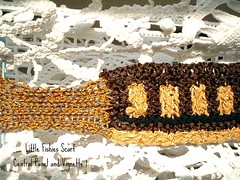
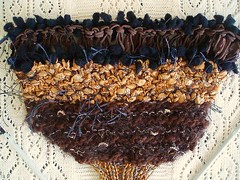
Little Fishies - done


Despite the various rounds of
frogging, this has been an
enjoyable process. The basic
idea was a brown scarf,
a little out of the ordinary.
In keeping with the fishies theme, I found that the color of a goldfish can turn into various shades of brown!

So there it is, beaded and glossed over,
and ready to wiggle and waggle its way...
the Little Fishies scarf.

Monday, October 5, 2009

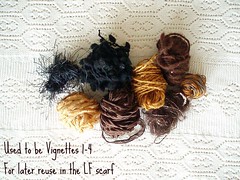
Back to Square One - LF Reknitting Vignettes


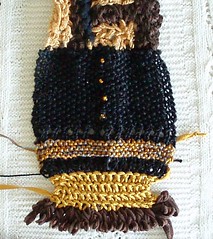
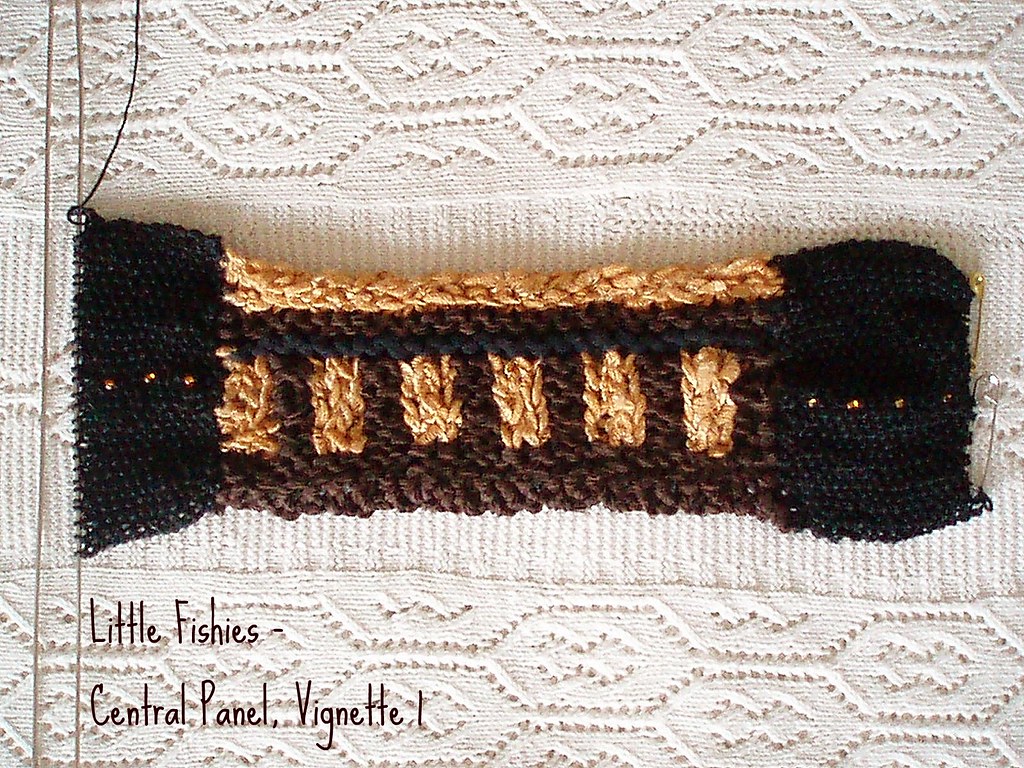
The NEW first vignette is made of of black DMC cotton, with a few knitted in golden seed beads.
Three rows of garter stitch MEZ embroidery floss, golden Anny Blatt ribbon, followed by dark chocolate brown Lana Grossa Sari, mirroring the Central Panel colour scheme.

The previous first
vignette was simply
too narrow and the
yarn for the second
vignette too thick,
which cause the
second vignette to
spread out too much.
So it was back to
square one, or rather to the central panel.

Wednesday, September 30, 2009

LF - Golden and Brown - Vignettes 1, 2, 3, 4,

Last day of a gloriously sunny September:
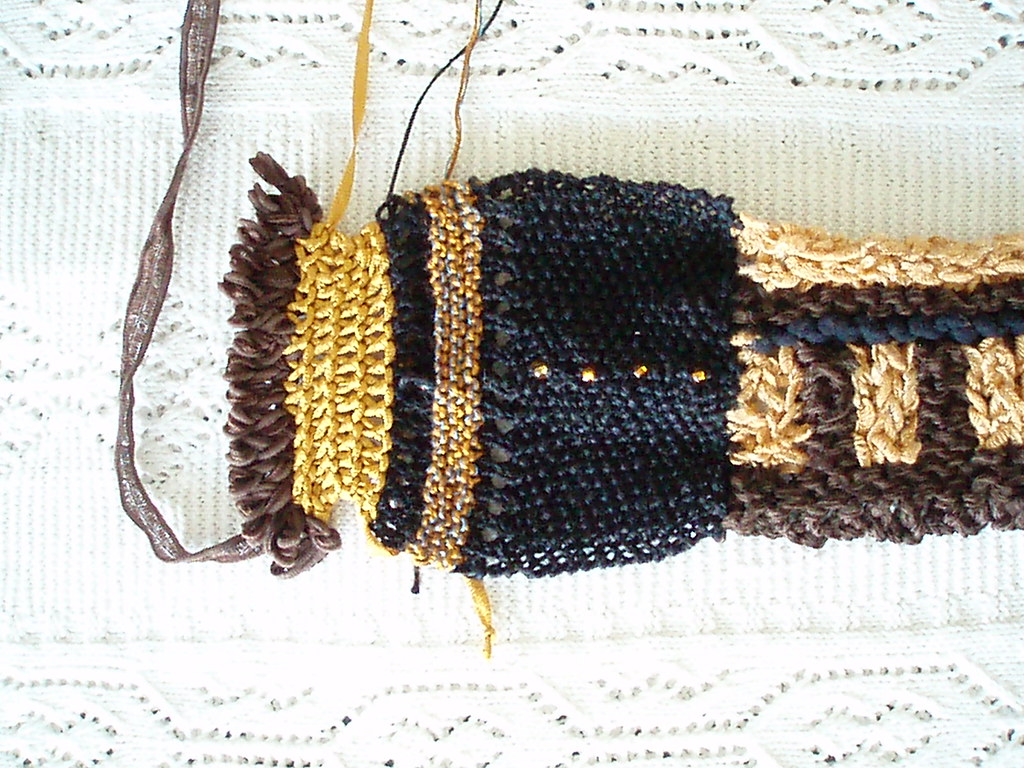
Added Vignette 1 to the left and right of the Central Panel.
I had no suitable multicolor yarn, so I plied one thread each of 6-split blue and brown MEZ embroidery floss skeins and of one Schürer JS mercerized curry-colored yarn. Both Vignette 1 parts hence are made of fine three-ply cotton and will wrap softly around the neck, not adding bulk either.
Added Vignettes 2, 3 and 4 on both sides.

Friday, May 22, 2009

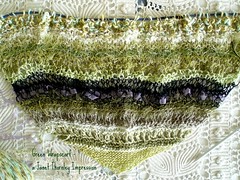
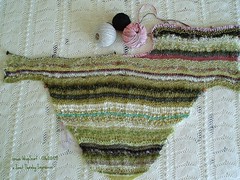
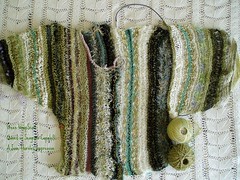
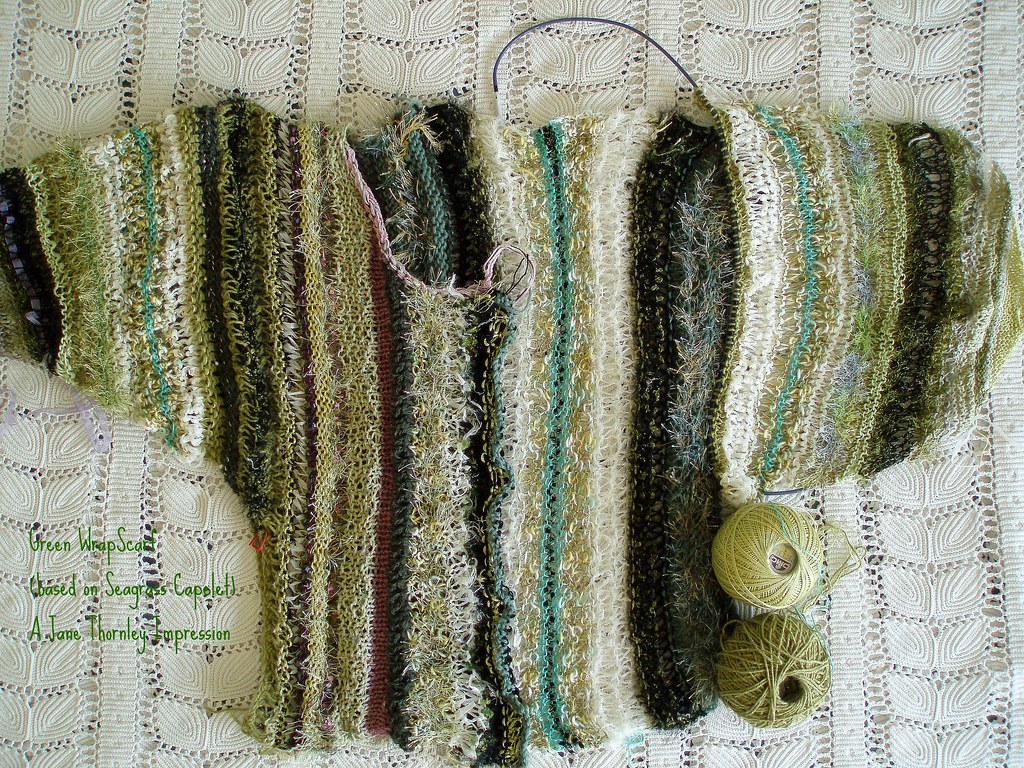
Green again - A Wrap Scarf Shrug Vest ...

Nature's many green colors outside and JANET THORNLEY's magnificent use of color in her projects led to this project - I will try not to get overboard with green stash picking!

For this multi-yarn project I am using Russian Grafting (Russian Join) in prominent places, such as the front closure or tip of the sleeves. See bottom of post for link to finished Kimono Vest...
Now be it a wrap, shrug, stole, capelet, vest or bolero - these are all less age-defining garments than most - maybe that advantage is one of the strongest appeals of Jane Thornley's patterns (i.e. non-patterns). They defy short-lived seasonal fashion, color trends, fancy line dictates, or fitting requirements, they are not country or continent-bound, they are perfectly practical, gently forgiving (spots and bulges don't show easily on a generous multi-color wrap), wonderfully warming, kindly concealing, fantastically flattering and fun to make. Whatever the outcome - it is sure to fit.


Progress: 20 June, 2009 -
the right front is finished.


Progress: July 2009 -
Click on Wrap Shrug for a larger picture, as it is taking shape.
This is how it looks so far, the left front needs
to be done, and then some beading and embellishing. As I post this, October is ending. I am definitely suffering under the multi-project syndrome, or rather:
so many projects - so little time.

Finished on 27 February 2010 - see post.