Showing posts with label Books. Show all posts

Monday, April 25, 2016

The Shortest Paths to Happiness - Literally!

Most business trips are clocked right through to the last minute. Exhausted at check-in, tired and hasty at check-out. Waiting for a cab.Heay rain. Cold wind. The e-mailbox is flodded. But listen: the flight has been delayed... an unexpected gift of an hour, sixty minutes, a huge gift or isn't it? If you are in any of the cities mentioned on this website of IDEAS.TED .COM - count yourself blessed, especially if you are a book lover. Getting from A to B might never have been that much fun! 
Silk Tassel and Silk Soutache Christening Bonnet on Wedding Pocket
Silk Lining of Christening Bonnet on Soutache Wedding Pocket
As a long-time traveler I always look for something interesting in places through which I pass on route from A to B. Travelling von Paris to Lyon, from Toulouse to Barcelone, from London to Manchester, from Chicago to St. Louis, and for the insiders of my blog followers: from Kleinheppach to Nogaret. These routes just packed with places in-between that I never visited or even knew of before I worked out detours in the un/likely event of an unexpected delay or change of means of transportation. Unlikely events? Strikes of tollbooth staff, flooding, cancelled flights due to vulcano eruptions, cancelled train connections because the tracks froze, gasoline shortage (remember those?), demonstrations, forest fires...
Silk Soutache ending in to a Bonnet Adornment at the Nape of the Neck
Soutache Lace Silk Christening Bonnet, with Embroidery and Silk Lining
Soutache adorned Wedding Pocket, lined with Orange Lace
Silk Tassel from Declercq, Paris (France)
Of course in my case I finecomb the routes for bookstores and any place connected to textile crafts, shops, museums or craft shows even. My next trip to Paris will include visits to tassel places. A gift from my god-daughter rekindled my desire to see these fluttering, silky, bejewelled works of art in some of those splendid tassel stores listed below. Above you can see beautiful examples of German Soutache (engl. also Soutache or Galloon), a soutachee being a woven flat rope, sometimes combined with a gold bullion thread or silk, and embroidered on costumes and uniforms in Napoleonic times. A Soutache is made of wool, silk, or cotton. There are tutorials on how to work with a Soutache braid on YouTube.

Les Passementeries de l'Ile-de-France/ - the very picture makes your heart beat faster.

Declercq Passementiers (© Declercq Passementiers, 15 rue Etienne Marcel, 75001 Paris). They even give a demonstration and lecture (in French) in the art of making tassels. If you leave this store with no purchase you will probably regret it for years to come!

Houlès Click on "Trimmings" and submerge yourself in colors, sheeny satin and silky glitter.

Verrier Père et fils They make simply out-of-this world tassels!

And if you wish to have your very own personalized custom-made tassel, turn to this company:
Jende Posamenten Manufaktur or just go for a walk through their site and enjoy looking at their amazing treasures.

Closing this post with an observation:

A child is toddling along the the sandy beach, stopping now and then, seemingly for no particular reason, and then just as spontaneously picking up speed for a short dash to the next invisible attraction. Apparently accompanying the child, an elderly woman is following smilingly, no hurry at all in her steps, her arms a bit stretched out, hands open as if ready to catch the child if need be, maybe the Grandmother. The child turns around to share his joy of having seen something new and the grandmother responds in kind with an understanding and reassuring smile. Treasured moments for both of them. And the onlooker. 

Saturday, July 18, 2015

Beads and Buttons and Books

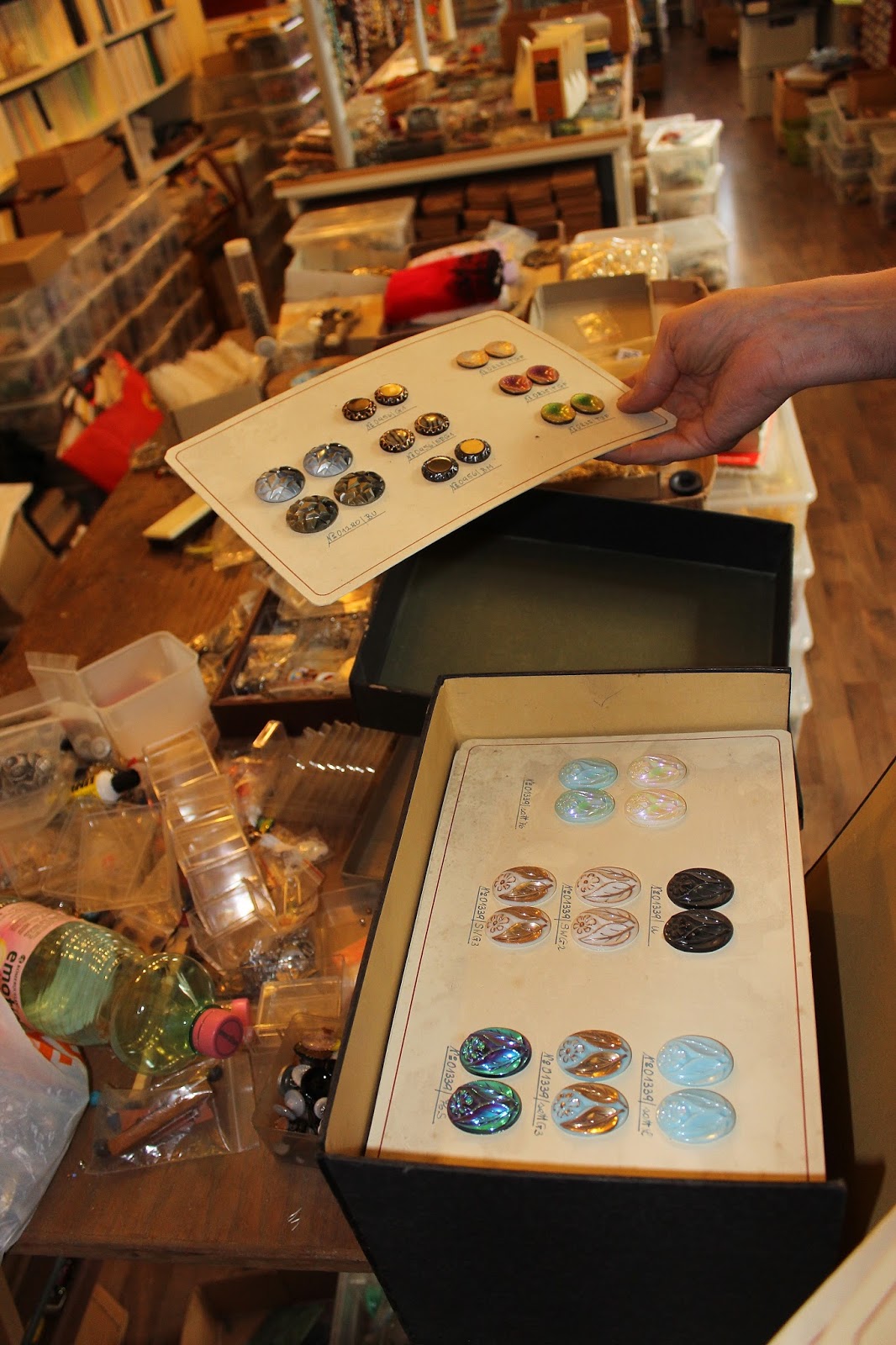
Three of my four favorite things to have or work with start with a "B" - but this store even has another "B", a collection of badges. Recently, I visited Vienna (Austria) and chanced upon this incredible shop for buttons and beads and books and beautiful old things one would probably call vintage today. I hesitate to use that expression -

A wall full of shining buttons and beads
it is not just vintage in the present-day interpretation of the term, these items are truly classic in their style, their usefulness and practicality is still present as is their beauty of design - they are the very essence of form follows function. Exciting examples of how to use buttons and beads and ribbons and lace are found in just one click - the creations of Mizzie Morawez!
A few steps into the store and your eyes start shining...
The owner, Mr. Thomas (Heinrich Thomas, Burggasse 11/1, 1076 Wien, Austria, Tel. +43-664-3580701; speaking German and English) is still driving to markets all over Europe where buttons and beads and antiques are offered and sold - a true collector and a treasure trove for anybody who appreciates his collection -

Entrance to the store for buttons and beads and badges and...
and yes, you may acquire most things you see in the store, be it old textile craft items or other interesting books, china, glass bottles, dolls... click here another description of the store.

Vases and mirrors
if you love such stores, plan on spending a lot of time there, sifting through the treasures... (also see my last blog post about this store which includes some information like opening hours, tel. number etc.)
Spend a day in a shiny store!
And what do you think is in the envelopes at the top?
...gilded buttons, studs and badges, all in absolute mint condition!
b
Treasures - hidden away for a long time
One should turn this beautiful shop into a museum 
Below some pictures of beautiful china and glass vases just waiting for you to take to your home ...
A thermo-clad coffee pot - in the style of Art Nouveau Bauscher Weiden

Lovely cups that want to be held in both hands...
These decanters look like a still life painting
I am sorry but the lace found its way into my bag...

This stirs every lace lover's heart!
Heinrich Thomas (Vienna) - one more link - click here
Read more on our trip to Vienna in these posts: Emilie Flöge and the Lady in Gold and Beholding Beauty


Tuesday, October 14, 2014

ART TEXTILE BERLIN IV - Picking up Threads

Our move from the vast and sparsely populated French Midi to mega-city Berlin requires a period of adaptation. Life in a beautiful place came to an end and is missed tremendously. Luckily, it is not material possessions we miss. It is friends one cannot easily visit any longer, it is my country cat Howard who did find a new home but is missed every day, and there is le Lauragais landscape, the infinite fields, wide horizons, Pyrenees mountains, the Montagne Noir, and the sky with sunrises and sunsets beautiful beyond description - all of this having been the main reasons for living in that part of France for almost two decades.
 Timbuctoo - adding new circles
In many ways we are lucky to have found a true home and friends in so many places, be it in Germany, the UK, the United States or in France - so I would like to belief that we will feel at home again someday in this big city of Berlin. I am slowly picking up my threads again in the truest sense of the word, getting my yarn stash organized and continuing dormant projects. The cowl Timbuctoo has made a few steps forward - moving along the road to Timbuctoo inch by inch so to speak. As one says, the path is the goal. And who says one has to hurry knitting ...


This is the last part of  ART TEXTILE BERLIN - highlighting a few more artists participating in the exposition in Berlin. The vast array of arts kept the visitor almost spellbound - each room held new surprises, affording lovely insights into old and new crafts and creations. Click here to see all four blog posts on ART TEXTILE BERLIN.

Two more works by Eva Lippert - showcasing her art in a glass cabinet. Such lovely gatherings of materials, be it beads or buttons, yarns or fleece, an almost transparent precious look at one time, darkly glossy and beautiful the other, combining knitting, crocheting, beading, quilting, weaving, just following the voice of the materials.

Mormon, Anne-Marie


- See more at: http://www.textile-art-berlin.de/teilnehmer/mormon-anne-marie#sthash.pdtXab17.dpuf

Beautiful gathering of sensuous materials

Mormon, Anne-Marie


- See more at: http://www.textile-art-berlin.de/teilnehmer/mormon-anne-marie#sthash.pdtXab17.dpuf

Mormon, Anne-Marie


- See more at: http://www.textile-art-berlin.de/teilnehmer/mormon-anne-marie#sthash.pdtXab17.dpu
Showcasing textile and beadwork delights
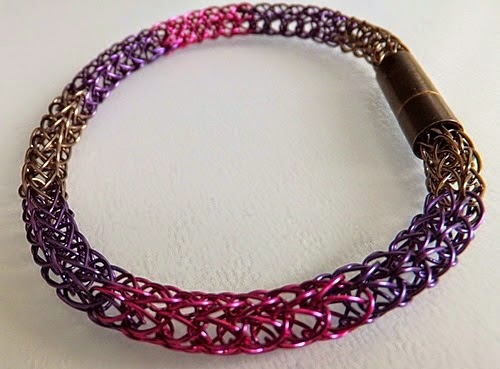
This tool Wikinger Strickliesel (Viking Spool) is used for making jewelry: wires are wound around a stick and calibrated. Naal binding is also a technique taught by Gabriele Kister-Schuler.

See this interesting blog by Tara for excellent pictures of bracelets made with the Wikinger Strickliesel. You can see how the wire is  wound and stitched around a stick, its size determinant for the length and diameter, crocheting in the round so to speak.

Jewelry made with Wikinger Strckliesel (spool knitting)
Bracelet made with Wikinger Strickliesel (Bracelet and picture by Tara)
Anne-Marie Françoise Mormon - glass jewelry, handmade of the finest Murano or Lauscha glass, using ancient glass winding techniques.

Rings - Jewelry and Photos by Anne-Marie Mormon
Closing this post with a picture of folded Origami ornaments, bringing bright rainbow colors into the church St. Maria, in Angermünde (Uckermark, Germany). I was thinking of how lucky we are that we are able to live in a safe place and how urgently we need to help those less fortunate.

If you wish you can leave a message via the comment link below or use the e-mail link in left column. Looking for a list of genuinely useful information and tutorials? See this post.

In all colors of the rainbow - Origami in St. Maria (St. Angermünde, Germany)


Yoomchi = Korean Art of Papermaking - Artist Sang Hoon Yang ”Love Song”, 600x1800m, Joomchi, Wire and handmade Paper. Hanji is strong and long-lasting traditional Korean paper, made from the inner bark of the dak (mulberry) tree, famous for its ability to resist fading, even after 1,000 years. This material is popularly used in the fashion industry, normal life and artwork creation, such as Yoomchi.

Thursday, February 28, 2013

Literally Touring Countries and Continents

Writing a blog and visiting the blogs of readers can hold many unexpected surprises. It literally leads to new literary ventures and adventures. I would compare it to opening doors to unknown worlds, holding secrets yet unknown. It is a bit like working freeform - patterns and yarns fall into place in structures one would consciously never have planned before the yarn went into this or that direction.


Maybe I was always aware of the popular saying that there are 'so many books and so little time' because I cannot think of a day I did not read at all.  When I was much younger, in a pre-blog and pre-Internet time, my reading mainstay were books written in English by English, Australian and American authors, as well as books in German, this being followed by a distant second from ROW - the rest of the world.


Sometimes authors from other continents and countries caught my attention in the bookstores I frequented or in magazines I read regularly. And it was always a very enriching first experience of 'discovering' authors for myself, old and new, until finally the map of my reads showed a bit more of a global balance.


In January 2013 I chanced upon the lovely blog of Vibeke from Norway "A Butterfly in my Hair". This sparked my interest in more contemporary Norwegian literature, quasi on top of those famous Norwegian authors of old we had read in school and the inevitable all-Scandinavian specialty of crime stories.

 
Novelist Per Petterson was the first author I chose, reading his book "Out Stealing Horses" - a novel having won an incredible array of awards. I was sad to put the book down after I had read it - as if it held a golden bowl of beautiful phrases and story lines that had suddenly come to an end - but they will linger on in my memory for quite a while.


Per Petterson is a famous writer, his books are translated into 60 languages and his work has won many distinguished awards and prices. As I said: so many books, and such little time... But please feel free to add your favorite book in the comments box at the end of this post!


This post is for Vibeke and her beautiful blog, generously introducing so many artists from countries around the world.


Speaking of Norway - don't we associate cold and long winters with Scandinavian countries? And long summers with short nights, and the further North we travel the longer the days until the sun never sets...

The above shown muffs in my No Chill series are useful against winter chills. Two square modules are crocheted together - you might recognize the POP blanket pattern?


A warm fleece-type fabric is cut to size and sewn together, forming a tube and sewn invisibly into the muff as a liner, making it reversable. Just before closing the last corner, I stuffed Scottish sheep fleece into the space between liner and knitted sleeve. Finally I added the the ribbed ends on either side (k2, p2) as cuffs, finishing the edge with a crocheted picot stitch. [Some muffs are for sale - please contact me via e-mail].

Wednesday, January 16, 2013

Entangled Structures of a Different Kind...


Scorpion SoupScorpion Soup by Tahir Shah
My rating: 5 of 5 stars

Starting my blog this year is a bit different from the years before - the topic is not textiles but certainly no less interesting, enjoyable and rewarding: Literature. Books and Textiles - two fascinating ways to enrich our days! The book I just read - Scorpion Soup - is a fairy tale. Many English review are found on Goodreads and Amazon - so here for my German readers is a German review, to whet you appetite for the forthcoming German copy. A link to the English E-Book Version on Amazon is at the end of this blog post. But yes, there is a textile teaser, could not do without it - look at the elegant opera glove below in this post, such masterful and elegant beadwork, and those beautiful colors!

Märchenerzähler – gibt es das noch? Sie sind rar geworden, und vielleicht lassen sich die Menschen nicht mehr ganz so leicht verzaubern, oft übersättigt mit Events und Terminen, mit GeTwitter und dem Strom der SMS- und Facebook-Nachrichten…

Und doch! Es gibt noch Erzähler von Märchen, die es vermögen, uns tausend Nächte und noch eine mit wundersamen Gedanken und Vorstellungen füllen können und uns zum Zuhören oder Mitlesen verlocken. Wie ein blanker Kieselstein, der in einen spiegelglatten See fällt und dort weite Wellen verbreitet und immer größere Kreise zieht, märchenhaft in Flüsse wandert und weiter zum Meer, so sind diese Märchen über Jahrhunderte lebendig geblieben. Wertvoll waren Märchen und Geschichten immer schon, sie wurden erzählt und weitererzählt und so bewahrt vor dem Vergessen, lange ehe das Schreiben weit verbreitet war.

Haben wir dann also heute noch Freude am Fabulieren? Am Versinken in Märchen, am Verfolgen von traumhaften Geschichten? Früher bewahrten Geschichtenerzähler mündlich Überliefertes, das seinen Ursprung in wahren Begebenheiten findet, sie trugen Legenden und Moralgeschichten vor. Märchenerzähler hingehen bedienten die Elemente der Fantasie, des Zaubers und des Fabelhaften. Magisch wurde man in den Strudel der Erzählung gezogen, eine Begebenheit versteckte sich in der anderen, Wege und Seitenwege taten sich auf und führten auf verschlungenen Pfaden zu einem unvorhersehbaren Ende – oder einem neuen Anfang?

Exquisite and elegant beaded glove 

"Scorpion Soup“ von Tahir Shah ist ein Märchenbuch in bester Erzähltradition, das alle Erwartungen erfüllt. Bei Tahir Shah ist das opulente Fabulieren der Ausdruck seiner Persönlichkeit und seiner Familientradition, er lebt in seinen Erzählungen und Büchern und lässt uns durch seine meisterhafte Erzählkunst mühelos in seine Fantasiewelt folgen. Man möchte meinen, dass er zum Erzählen geboren sei…

Wie soll man dieses vielteilige Märchen in seiner Mannigfaltigkeit in wenigen Worten bewerten? Fast scheut man sich davor, die Kapitelinhalte schnöde in ein paar Sätze zusammenzufassen, wie bei einem Sachbuch oder einem Reiseführer, einem Buch aus der realen Welt.

"Scorpion Soup“, das sind achtzehn kunstvoll ineinandergeschachtelte märchenhafte Begebenheiten, spannungsreich geschrieben, brillant und fantasievoll erzählt, wird man doch fast unmerklich von Kapitel zu Kapitel geführt. Jedes der Kapitel schlägt den erwartungsvollen Leser erneut in den Bann und verleitet ihn zum Weiterlesen, man wird zum staunenden Kind, erlebt aufs Neue die Freude am Zu-Hören von geschriebenen Worten, und wie in vielen Märchen bleiben in Tahir Shahs Buch Freiräume für eigene Ideen und ausufernde Fantasien, für endlose Spekulationen über den Ausgang der Erzählung oder über das weitere Schicksal der beschriebenen Personen. Ein Buch ganz zweifelsohne für Kinder und für Erwachsene, ein Buch zum Abschalten und Träumen, zum Vergessen der Alltagsrealitäten, oder einfach zum Freuen.


Oak Trees in Winter - Time for Fairy Tales
The beaded glove picture is a pin from Pinterest from Daria Nassiboulina.
For a translation of this post click on the button "Translate" at the right side.
Another book I recommend in this context is "101 Nacht" - Arabian Tales translated for the first time by multi-talented Claudia Ott.The handwritten tales are kept in the Aga Khan Museum. To my knowledge it has not yet been translated into English to date.


View all my reviews

Saturday, May 15, 2010

A Greek Pyramid Poem

Sometimes it is just a small poem or a sentence that will bring new understanding, reflection or interchange of thoughts and ideas. In light of the Burqa (burqu‘ )-discussion in Europe I kept on wondering about the concept of Strangers and what makes people strangers or strange to the beholder, who vice versa is seen as a stranger or strange as well. An interesting book on this subject is Beyond Beards and Burqas.

A Pyramid Poem written by Ntinos Siotis in Athens, on 22 July 1996 and published in his collection of poems Mouseion Aeros. Here's an unofficial translation into English:

HOW STRANGERS DO SEE US 
How do strangers see us?
Do strangers see us?
Do strangers see?
See strangers?
Strangers?

There is an interesting article on Concrete Poetry on Wikipedia:
"Concrete poetry or shape poetry is poetry in which the typographical arrangement of words is as important in conveying the intended effect as the conventional elements of the poem, such as meaning of words, rhythm, rhyme and so on. It is sometimes referred to as visual poetry; a term that has evolved to have distinct meaning of its own, because the words themselves form a picture. This can be called Imagery because you use your senses to figure out what the words mean."
Applied to knitting - visual poetry expressed in a beautiful lace pattern, such as stars, leaves, trees and other distinctive ornaments also form pictures - I'd love to call it "Imagery Knitting", like the pattern of "The Tree of Life" (here from Fairy Stitch Sarah) or Lily of the Valley by Herbert Niebling.
In Freeform Knitting a perfect example would be the "Frond" wrap by Jane Thornley

Imaginative Imagery Knitting. 

Most wraps and shawls are images of Pyramid Poems, one could even follow an equation of one word-one stitch pattern, all realized in color and transporting sensory characteristics, the feel, the warmth, the shape and visual appeal. Why not start a textile project based on your favorite Imagery like Edgar Varese did in his experimental music? 
31 May: Jane Thornley's thought-provoking new issue of the Inspired Knitters Club just arrived today. As it were, Visual Knitting - Imagery Knitting - is the main topic and her inspirational tales tell the story behind her patterns and suggest the roads to travel to new visual horizons.


Tuesday, April 13, 2010

Tinkers - A Debut Novel by Paul Harding

To pass the time waiting at yet another airport gate and without my knitting due to security regulations I took the book TINKERS by Paul Harding with me. His debut novel, it was published in January 2009 and has 192 pages. A small book but a forceful, spellbinding and impressive one, a book leading to contemplation, reflection and soul-searching. The story tells about a tinker, Howard, a man mending broken pots and pans, a man standing for a vanished lifestyle, when time appeared to run at a slower pace and yet the days were full.
And it is the story about another man, the late tinker's son George, who is slowly dying, in the house he built and amidst his family and all his lovingly repaired antique clocks, his entire life achievements if you will. The book deals with the relationship between a father and a son, and although Harding writes in great prose about the subject of the last days of life and impending death, in effect weaving through three generations, it is truly a comforting book, somehow giving the reader solace through knowing what a rich, life-affirming and fulfilled life the main characters enjoyed. A spiritual story told in a strong narrative voice.
As it were, Tinkers won this year's Pulitzer Prize for Fiction today, 13 April 2010.


As we get older - here a lovely poem of which most people know only the first line:

Warning

When I am an old woman I shall wear purple
With a red hat which doesn't go, and doesn't suit me.
And I shall spend my pension on brandy and summer gloves
And satin sandals, and say we've no money for butter.
I shall sit down on the pavement when I'm tired
And gobble up samples in shops and press alarm bells
And run my stick along the public railings
And make up for the sobriety of my youth.
I shall go out in my slippers in the rain
And pick flowers in other people's gardens
And learn to spit.

You can wear terrible shirts and grow more fat
And eat three pounds of sausages at a go
Or only bread and pickle for a week
And hoard pens and pencils and beermats and things in boxes.

But now we must have clothes that keep us dry
And pay our rent and not swear in the street
And set a good example for the children.
We must have friends to dinner and read the papers.

But maybe I ought to practice a little now?
So people who know me are not too shocked and surprised
When suddenly I am old, and start to wear purple.

Jenny Joseph

Monday, March 2, 2009

Sizing Down

Sizing Down - this does not refer to reducing my pack-rat yarn stash, oh no! And books cannot be thrown out anyway, they have an invisable pass-on label stuck to them right at the time of their purchase.

But I am actually disposing of things, passing them on or channeling them to suitable recycling places: stacks of decades-old newspaper clippings with then important news. Recipes I never made. Letter openers. Old calendars. That magnificent pen that doesn't smudge but has no refill, unless I use it to make a more hand-friendly crochet hook. Fabrics I had saved for decades to make just that dress. My first ca. 1950 camera, an Agfa Box, in perfect working condition but no available films any more, such as with our Polaroid camera from the late sixties - the production of suitable films ceased this year.

Sizing down a library - almost as impossible as reducing my yarn stash. There are antique books, classics and modern literature. There is National Geographic, every issue since 1965. I set some books free on Bookcrossing but sadly the finders did not continue the thread - now I will take some to the Village of Books (Wiki). Favorites will go into the library of a friend who is planning his years of the third life-cycle - for him I create a list of all books I want to donate. And many will find a home with family members.

And while noting down title and author I noticed that so many books claim "The Greatest Novel of Our Time". Our time, a vague and continually changing concept. Many great novels of their time remain as such only in the minds of their also aging readers. For everything there is a season...

Sizing down on china - now that is a really worthy project! All those candle stick holders, small vases, little pots of enormous variety, the umpteenth coffee mug, all precious and wonderful gifts from dear friends and nice visitors. How to keep all this? Downsizing gifted things is most difficult, 40 years of hanging on accrued substantial cubics of items. And alas, once we have passed away that little crystal-cut vase for violets will not be remembered as a special birthday gift from my mother who sent it to me when I was an Au-pair girl in England. The postage itself was so high she must have thrown all thrifty thoughts to the wind at that special moment when she mailed it to me.

So I am leaving small vases, little pots, candle stick holders, mugs and the odd cup and plate on the vendor tables during the occasional flee-market, vide-grenier, Flohmarkt for others to pick up and have their own story behind their finds. I leave them on park benches with fresh flowers in them or gift-wrapped and filled with flower seeds from my garden. I ask family and friends to take their pick - and so the china stash lives on somewhere else!

I am also adamant, or at least try to be, about NOT buying any more things that I do not REALLY need to STASH - with the yarn and book exception, of course.

Clothing: T-Shirts - just how many do I wear in comparison to what I have? Heavy Jeans a tad too big - will I grow into them again? I doubt it. Age-shrinkage has set in. Shoes: a big foot size with a yearning for elegant heels... long since given up and passed on to ladies with a penchant for balance.

Definitely living on with me are those shawls and shrugs and wraps that defy style, age and fashion. They are indeed ageless and never go out of style and fashion, at least if they were not made under the constraints of an annual fad. A perfect example are freeform garments, on the forefront of those the lovely non-patterns by the Queen of Free-Spirited Colors, Jane Thornley.

Pictures and photographs - now there are difficult decision to make. I started putting names and dates on the back of old family photographs, lest I forget or the children have no notion of who that person in the picture was and what was the occasion. Unless they are in scrapbooks, pictures of general interest simply go into boxes, labeled year-wise, or approximately so. Pictures that would mean nothing to anybody else but me find burial in the paper bin.

Why downsizing?
An age process, I suppose, of which one becomes more aware with every year past 65 or so. Starting to seriously face the prospect of eventually leaving a larger space in exchange for various and continually smaller ones. So I am parting with things the way I want to, a slow denuding process to be sure, but bit by bit... The pack-rat behavior of a child having grown up during war and post-war times, when one just hung on to everything irrespective of its inherent worth, has changed to the desire to do without.

On travels one now commits impressions only to memory, knowing full well that this is and will also be a transient process. But what more vivid impression is there to take but a 360° view of a wonderful landscape? The green lushness framing a waterfall on the Big Island of Hawaii? Listening to baroque music played in a park on a summer evening? The sight of Indian women walking along village streets wearing nivi-style sarees of stunning colors, the enrapturing red color scape of hues of a sunset on the walls of a village in Morocco... all this would be hard to capture with a mere picture anyway, as all these events touch all senses.

Wednesday, February 11, 2009

Thoughts on Journeys and a Special Book

It is good to have an end to journey towards,
it is the journey that matters in the end.

Der Weg ist das Ziel.


This is a wonderful way to describe a textile project - the joy is in the making, the choosing of colors and the feel of yarns, the selection of techniques, the combination of shapes and forms, the joy of watching it grow and gain in substance, transferring the image from one's mind into a very real and touchable object.

Sunrise


The English citation is from Ursula K. LeGuin. Three of her books were finalists for the Pulitzer Price and the American Book Award. Her book Searoad is masterful, insightful and deeply moving. "Le Guin explores the dreams and sorrows of the inhabitants of Klatsand, Oregon, a beach town where ordinary people bring their dreams and sorrows for a weekend or the rest of their lives, and sometimes learn to read what the sea writes on the sand. Searoad is the story of a particular place that could be any place, and of a people so distinctly drawn they could be any of us."

Her mother Theodora Kroeber wrote the book Ishi in Two Worlds, an absorbing drama about the last survivor of the Yahi American Indian tribe.