In Japanese there is a wonderful expression:
aaware. It refers to the special beauty of the volatile, transient: the cherry flower, the first snow, a shooting star passing across a nightly sky.
But as fleeting as it might be, its impression often stays on in our memory for a very long time.
I was ten years old and stayed with my god-mother who lived close to the Dutch border. She was expecting her first child and I was thrilled that I could feel the yet unborn baby kicking inside the belly, and it was as if I had created a touching bond with the invisible child. My vacation with my aunt Luise was pure bliss and this blog entry is written in rememberance to her. She loved to laugh and tell funny stories, her southern Swabian dialect as strong as ever as if she had never left home. But instead of adapting to the local lingo and northern vocabulary, she introduced her own familiar dialect and expressions to the villagers, and the butcher, the baker and the lady at the garden shop, everybody smilingly added her vernacular to their own command of the language.
On a sunny day we went to
Scheveningen. At that time it was an exciting excursion, involving hours of driving in a car and going "abroad" to the Netherlands at that, passports had to be presented and stamped at the border, a small suitcase was packed.
And then, finally, the overwhelming first view of the ocean! It was more mighty and endless than I could ever have imagined. Nothing framed the horizon but the sea and sky. It was a windy day, the waves thundered in and the wide sand beach was glistening with the froth whipped in by the wind. The air had a taste new to me and when I had the first waves whirl around my bare feet it seemed like a miracle from heaven, so cool, so fresh and so much alive.
What astounded and fascinated me most about the sea were the many colors. I had vaguely assumed a
blue
like the sky on a summer day. But the variety and innumerable shades of
blue amazed me and I still find it fascinating to stand at a beach and
look out to the ocean and marvel at the ever-changing spectrum of shapes
and colors.
Looking out to the
Boulevard Beach was the
Kurhaus Hotel, maybe then as popular as it is today (see the present-day
Kurhaus), and to my surprise and delight my uncle and aunt decided to have an afternoon treat at the Kurhaus, coffee and cake, and for me an incredibly tasty, thick hot chocolate drink. I felt like a million and as happy as a child can only be.
The chocolate / cocoa brand was Droste, of course, the chocolate maker Droste famous for the visual effect on its boxes of cocoa, the socalled "Droste Effect" as shown
here. Can you detect the many images each in a yet smaller scale? The site will take you further and lead you to the most interesting work of M.C. Escher and the
Droste effect, and anybody interested in patchwork designs will find
this a challenge to replicate.
When driving through the dainty Dutch villages I noticed that the windows were often dressed up with short lace curtains. There were even patchwork lace curtains, stitched together unevenly but still looking absolutely beautiful in my eyes.
I took home with me an experience and the memory of a wonderful day I haven't forgotten in more than 60 years, witness to the poem that True Happiness is the Absence of the Striving for Happiness (
Zhuangzi). The day was simply magic.
I still love the color of blue with all its shades and in all its uses. Its history is fascinating, such as
The War of the Blue - Indigo Versus Woad, and items dyed with woad into a lovely pastel blue are still made today in an area in France called
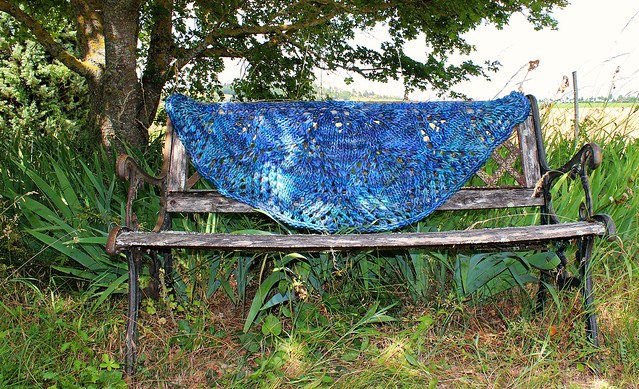
Le Pastel (Lauragais) amongst other places. Blue is "azul" in Spanish and I named my shrug (see below) Azul, the lovely pattern
Ovate is by Toni Gurbisz.
The shrug Ovate is for Sale - contact me.
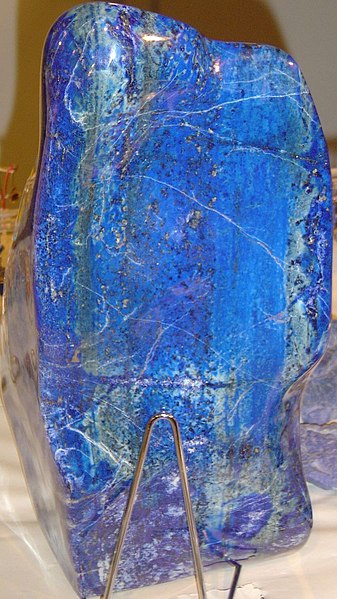
A favorite blue of mine is Lapislazuli, and I like to use it in combination with some yellow and green as in the
Blue Morpho Papillon bolero.
Feel free to add your own story of how you saw the ocean for the very first time!