Showing posts with label Hat. Show all posts

Sunday, March 3, 2019

Springtime Cowl and Beanie

The winter of 2019 seems to be just as endless in Chicago Land as last year's - so I thought that my friend Barb might welcome the warmth of a cowl - doubling as a beanie for the really Chicago-windy days - and in the spring color of green, with a few red, blue and yellow beads thrown in for good measure as a stand-in for spring flowers!

 Springtime Cowl and Beanie

The pattern is called: Barb’s Springtime Cowl and Beanie!

First: It is a cowl. Secondly: It is a beanie. Thirdly: You can wear it with the greener part at the top or at the bottom, upside down, inside out. And finally: The I-cord is removable and can be woven through the holes between the stitches either at the top or at the bottom. I crocheted the last two rows and the elastic bind-off to make an even hole-spacing for the I-cord.

 Springtime Cowl and Beanie
 Springtime Cowl and Beanie
After weaving the I-cord through the spaces between the stitches, pull it tight, make a bow and there you go, take a bow! Wear your beanie upside down whichever way you please. Oh yes, lest I forget, if you don't want the I-cord to show you can gather the cowl together at the top with the I-cord, make a bow, turn the cowl - now a beanie - inside out and there you go. How versatile is that!

Springtime Cowl and Beanie - I-Cord
Springtime Cowl and Beanie

Of course there is the option to wear it inside out and upside down, but that is totally up to the wearer-ess. The spiral-like green beads on the one end I bought in Shanghai in 2008. The colourful Rocailles (beads) I bought in Vienna in an incredibly well-stocked bead shop sometime at the beginning of this century. And the various yarns were bought during the past 6 decades of picking up so-called orphan yarns, i.e. where only one or two skeins are left in an orphan basket in yarn stores of every country we visited. Now they are orphans no longer but united in a hopefully useful accessory. They are in the colors of spring flowers. 
So there you go! An international Barb Beanie and Cowl!

 
Succulent - not a cowl or beanie, but green!

Wednesday, January 27, 2016

Colors to Lift Your Spirits - Starting with Green

Although winter temperatures and trees bare of leaves will still be with us in the northern hemisphere for another month or so, I am now starting to knit colors for spring. These two hats are made with fuzzy yarns from my stash, one of them adorned with a pink heart for that little girl somewhere in a migrant welcome center in Berlin.
Spring Green Hat for a Baby
I used the Emily Ocker cast-on and German Short Rows for the earflaps. Adding a new color when knitting in the round: "jogless" is what you want so see this tutorial on how to joing a new color to your hat. I-cords and a little heart-shaped button - and the hats were ready to start their travels. For more helpful hints click here
and go to bottom of posts.


Spring Green Hat for a Toddler

O how I long again to see
The vernal face of Spring,
And hear, from every budding tree,
Some little warbler sing.

I long to see the forest trees
Clothed in their robes of green,
And swaying in the gentle breeze
Display their glossy sheen.

I long to wander by the stream
Where sport the speckled trout,
Or in the noontide's genial gleam
See lambkins frisk about.

I long to see the sons of toil
Perform the noble deed
Of breaking up the stubborn soil
To plant the fertile seed.
 

I long to see the meadows green
Bespread with flowerets gay--
I long to have a change of scene
From winter cold and gray.

It won't be long--a little while
And snows will disappear
And Flora with her winning smile
Shall find a welcome here.

A poem by S. Moore (Canada)

Monday, January 25, 2016

At the Beginning of Year 2016

we are all hoping that this year things will take a turn for the better. There were so many tragic events and a lot of grief and sadness during the past year. The hope for freedom and safety drew refugees across dangerous seas, and they were welcomed with open arms or rejected on the grounds of many reasons, an uncertain future awaiting them either way. Nobody knows overall solutions to those troubling problems... But at least we can try and help.
Snow Hat
Last year, I began knitting items for children as my contribution to help people coming into Germany. They are ill prepared for cold winters and snowy conditions and so I thought of hats:

Snow Hat - fluffy white with gold sprinkles
This is a nice pattern, a hat with inbuilt ear flaps, using a light color to make the wearer visible and thus safer during the dark winter hours. Story behind it:

Snow Hat
After I had already started and been about halfway, I was not happy with my winged earflaps. So I did an earflap hat/cap pattern search on Ravelry, a search which was followed by a determined and quick frogging activity.

Snow Hat - moss stitch brim
Using fancitiger's pattern "Ice Skating Cap" I quickly knit up this pretty cap plus two more and dropped them off at one of those collection centers for items useful for refugees. It warms my heart to think they will warm somebody's ears...

Snow Hat - creamy white and gold
I love to knit. Sometime people ask me why I knit. The very question can only come from somebody not involved in textile crafts. Knitting, crochet and other textile techniques involve the brain and the heart and soul simultaneously. While I knit, I can think of wonderful events in my life - especially of my family and friends and cats, as well as of the many wonderful homes I've lived in in a number of countries. In short: it makes me happy.

Winter Morning - Le Lauragais
Observations -  "A small child is toddling along the sidewalk, stopping now and then, seemingly for no particular reason, and then just as spontaneously picking up speed for a short dash to the next attraction, seemingly invisible to everybody but the child. The adult following the child smilingly seems to have no hurry at all in her steps, her arms are a bit stretched out, hands open and ready to catch the child if need be. The child laughs and turns around to share his joy of having seen something new and the grandmother responds in kind with an understanding and reassuring smile."
Frosted Berries (Copyright Valerie Mader)

Monday, February 24, 2014

Spring Time in California

My god-daughter's smile needs special blog posts - please first read this post "The Most Precious Gifts". By now, the woolen reversible hat made its way across the ocean and the United States and finally into the hands of Braden, whom I have known even before she was born...
The double layers are indeed providing a lot of warmth during those winter season trips to New York or the Windy City.
For Igloo-cold weather conditions
Black on one side, blue with a black brim on the other side
I am now thinking of a spring / fall version in cotton and linen lace...
For information on how to knit this 2-color reversible hat please read this post in my blog

Tuesday, January 7, 2014

The Most Precious Gifts

Once again we realized during Christmas that the most precious gift we can give or receive is indeed very personal: it is the person itself, spending time with us. What joy the visit our our daughter and god-daughter brought us! Add to that the first hand-written Christmas Card envelope by our grandson Victor! Another special gift were those thoughtfully phrased Christmas mails I received from Ravelry friends across the world. A wonderful way to start the year 2014. 
Friendship across continents
OMA + OPA - written by grandson Victor in December 2013
On the first day of the new year, we had the traditional German New Year's Brezel (Neujahrsbrezel), made quite unconventionally by our daughter - and I was wondering why I was always taking the long route for making a yeast dough while her accelerated method definitely produced the same results, or even better! It is said that haveing a slice of the New Year's Brezel for breakfast will bring luck throughout  the coming year. Write to me for the recipe if you are planning ahead...
New Year's Brezel - Neujahrsbrezel - (©) Picture by Valerie Mader
It is still winter, a very harsh one in many places of the northern hemisphere, especially in the United States and Canada - and although my god-daughter lives in the US sunbelt she still loves warm hats. It adds to her personal look and comfort. A personal look evolves over time, deviations are allowed and even called for, depending on the season, mood and occasion. And today, the liberty of wearing what one likes and can afford is an immense advantage from the situation just half a century ago. Luckily, the sixties were the time when designers like Mary Quant and model Twiggy came along and triggered an avalanche of fashion changes.
So for my amazing Californian god-daughter often traveling into colder areas of the world, here is the prototype hat in the making: Some bulky wool, a lacy layer of thin mohair, and the reversible hat, knit in the round, is ready for those colder days in two looks. See the finished hat in the next post.
I have seen this free pattern idea somewhere (probably on Ravelry), while the origin of the hat design is unknown. Please contact me if you happen to know the source as I wish to give credit to the designer. It might not be exactly the same because I just memorized the basics some time ago and then winged it. 
The lacy side provides extra warmth and makes the hat unmistakable if worn lace outside. I cast on 72 stitches with a stretchy cast-on method, trying out The Chinese Waitress method, a new one for me and I have no idea from whence it got its name - a bit cumbersome but veery stretchy. Join to knit in the round. Knit the brim of the hat k4, p4 until you have the desired brim height. See the finished hat in this post.


Thursday, January 7, 2010

Windschief for Jaap - Pattern by Stephen West


The Windschief hat pattern was designed by Stephen West.
It is an easy knit with a twist, a surprising stitch-decrease pattern. I used an Italian cast-on, then a Row 1 following an Italian cast-on, and for the bottom ribbed edge I used the Eastern Uncrossed Brioche stitch for more elasticity and extra warmth!
Windschief is a German word, literally wind-askew. Like gnarled tree trunks bent by relentless winds or the way creaky old houses are leaning sideways. If one wears a hat askew, the hat sits windschief on one's head!

Our Dutch friend Jaap does a lot of work outdoors so he really needs this oranje hat!
(Link to the German Windschief pattern)

Monday, February 23, 2009

Getting close...


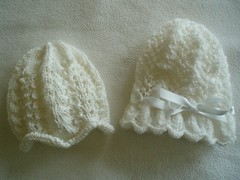
Two white baby bonnets completed last night - and the package is posted and on its way to the UK. The bonnet with the ribbon is Rose-of-Sharon pattern by Angela Hahn, for the other bonnet I used a regular feather and fan pattern.

Monday, February 2, 2009

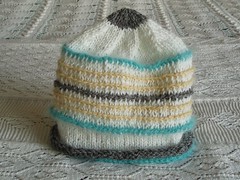
Baby Pagoda Hats - White and Red


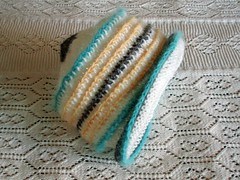
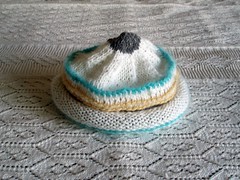
A Pagoda hat, folding in neat accordion-like sections, to add to our grandchild's layette.
Number of stitches for CO and decrease instructions are taken from Ulli S. Shibuya. Changes are mine. Reduce or enlarge CO in multiples of 8. All colors given are suggestions only, go ahead and dig deep into your stash!
CO 72 stitches, distribute evenly on 4 dpn or circular needle/s. Knit in the round for 8 rows in grey, then switch to white and knit another 8 rows. Crochet (dc UK; sc US; fM German) 1 round in turquoise. Knit 3 rounds in white. Crochet 1 round in yellow. Knit 2 rounds in white. Crochet 1 round in yellow. Knit 2 rounds in white. Crochet one round in grey. Knit 2 rounds in white. Crochet 1 round in yellow. Knit 2 rounds in white. Crochet 1 round in yellow. Knit 3 rounds in white. Crochet 1 round in turquoise. Knit 6 rounds in white.

Start decrease:
Round 1: *knit 2 tog, knit 6*, repeat8 times. Round 2: knit Round 3: *knit 2 tog, knit 5*, repeat 8 times. Round 4: knit round 5: *knit 2 tog, knit 4*, repeat 8 times. Round 6: knit
Decrease in the above manner, every second round with one stitch less in between the "knit 2 tog" until there are 18 stitches left. In the following round: "knit 2 tog" = 9 stitches left. Knit 1 round. Run thread through remaining 9 stitches, pull together and weave in thread.
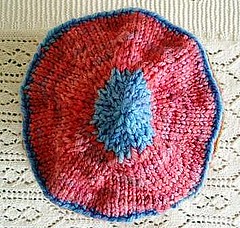
Turn the Pagoda Hat inside out. Using turquoise, crochet one round of dc (sc, fM) into the first white blibs, which originated with the color change from grey to white. This will stabilize the edge, prevent it from rolling in further and keep the Pagoda Hat fitting snugly around the baby's head.


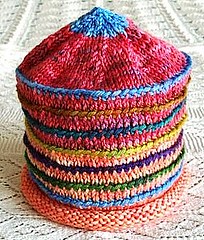
Another version of the Baby Pagoda Hat, this time in a happy pinkish red with colorful stripes. For a jogless color change see this very helpful tutorial by TechKnitting or here.

Baby Pagoda Hats - White and Red


A Pagoda hat, folding in neat accordion-like sections, to add to our grandchild's layette.
Number of stitches for CO and decrease instructions are taken from Ulli S. Shibuya. Changes are mine. Reduce or enlarge CO in multiples of 8. All colors given are suggestions only, go ahead and dig deep into your stash!
CO 72 stitches, distribute evenly on 4 dpn or circular needle/s. Knit in the round for 8 rows in grey, then switch to white and knit another 8 rows. Crochet (dc UK; sc US; fM German) 1 round in turquoise. Knit 3 rounds in white. Crochet 1 round in yellow. Knit 2 rounds in white. Crochet 1 round in yellow. Knit 2 rounds in white. Crochet one round in grey. Knit 2 rounds in white. Crochet 1 round in yellow. Knit 2 rounds in white. Crochet 1 round in yellow. Knit 3 rounds in white. Crochet 1 round in turquoise. Knit 6 rounds in white.

Start decrease:
Round 1: *knit 2 tog, knit 6*, repeat8 times. Round 2: knit Round 3: *knit 2 tog, knit 5*, repeat 8 times. Round 4: knit round 5: *knit 2 tog, knit 4*, repeat 8 times. Round 6: knit
Decrease in the above manner, every second round with one stitch less in between the "knit 2 tog" until there are 18 stitches left. In the following round: "knit 2 tog" = 9 stitches left. Knit 1 round. Run thread through remaining 9 stitches, pull together and weave in thread.

Turn the Pagoda Hat inside out. Using turquoise, crochet one round of dc (sc, fM) into the first white blibs, which originated with the color change from grey to white. This will stabilize the edge, prevent it from rolling in further and keep the Pagoda Hat fitting snugly around the baby's head.


Another version of the Baby Pagoda Hat, this time in a happy pinkish red with colorful stripes. For a jogless color change see this very helpful tutorial by TechKnitting or here.

Baby Pagoda Hats - White and Red


A Pagoda hat, folding in neat accordion-like sections, to add to our grandchild's layette.
Number of stitches for CO and decrease instructions are taken from Ulli S. Shibuya. Changes are mine. Reduce or enlarge CO in multiples of 8. All colors given are suggestions only, go ahead and dig deep into your stash!
CO 72 stitches, distribute evenly on 4 dpn or circular needle/s. Knit in the round for 8 rows in grey, then switch to white and knit another 8 rows. Crochet (dc UK; sc US; fM German) 1 round in turquoise. Knit 3 rounds in white. Crochet 1 round in yellow. Knit 2 rounds in white. Crochet 1 round in yellow. Knit 2 rounds in white. Crochet one round in grey. Knit 2 rounds in white. Crochet 1 round in yellow. Knit 2 rounds in white. Crochet 1 round in yellow. Knit 3 rounds in white. Crochet 1 round in turquoise. Knit 6 rounds in white.

Start decrease:
Round 1: *knit 2 tog, knit 6*, repeat8 times. Round 2: knit Round 3: *knit 2 tog, knit 5*, repeat 8 times. Round 4: knit round 5: *knit 2 tog, knit 4*, repeat 8 times. Round 6: knit
Decrease in the above manner, every second round with one stitch less in between the "knit 2 tog" until there are 18 stitches left. In the following round: "knit 2 tog" = 9 stitches left. Knit 1 round. Run thread through remaining 9 stitches, pull together and weave in thread.

Turn the Pagoda Hat inside out. Using turquoise, crochet one round of dc (sc, fM) into the first white blibs, which originated with the color change from grey to white. This will stabilize the edge, prevent it from rolling in further and keep the Pagoda Hat fitting snugly around the baby's head.


Another version of the Baby Pagoda Hat, this time in a happy pinkish red with colorful stripes. For a jogless color change see this very helpful tutorial by TechKnitting or here.